Mountain View Zip Code Price Comparison by Neighborhood
August 27, 2026
August 27, 2026
A buyer touring homes in Mountain View this summer can walk two blocks in the Cuesta Park area and cross from one school district into another without a single visual cue. No sign marks the line. No listing photo shows it. But agents who work this market know the boundary by heart, because it routinely adds tens of thousands of dollars to a comparable home on the correct side of it. That line, not the city's overall median price, is a better starting point for understanding what your money buys here.
Most buyers start their search with a single number: Mountain View's citywide median. Redfin put that figure at roughly $1.9 million for the three months ending May 2026, essentially flat compared to the same period a year earlier, with homes going under contract in about 10 days on average. Zillow's home value index landed close by, near $1.96 million as of early August 2026. Those numbers are accurate. They are also close to useless if you're deciding between a bungalow near Castro Street and a ranch house three miles south, because Mountain View isn't one market. It's several markets that happen to share a mailing address.
Mountain View splits into three residential zip codes, and the pattern in the pricing data runs counter to what most buyers expect. Realtor.com's snapshot from December 2025 showed a median of roughly $2.12 million in 94041, the downtown zip code anchored by Castro Street and the Caltrain corridor. Zip code 94040, which covers the south and central neighborhoods including Cuesta Park, Waverly Park, and Old Mountain View, came in lower, around $1.38 million. And 94043, the northern zip code that wraps around Google's headquarters and includes Monta Loma and Rex Manor, sat lower still, near $1.26 million.
| Zip Code | Area | Median Sale Price (Realtor.com, Dec. 2025) |
|---|---|---|
| 94041 | Downtown, Castro Street corridor | ~$2.12 million |
| 94040 | South and central, including Cuesta Park, Waverly Park, Old Mountain View | ~$1.38 million |
| 94043 | North, including Monta Loma, Rex Manor, Google HQ area | ~$1.26 million |
If you assumed the larger-lot, single-family neighborhoods south of El Camino Real would command the highest prices in the city, this table says otherwise. Downtown's median outpaces both of them by a wide margin. Part of that gap comes down to a mix effect: 94041 includes newer condo and townhome product alongside preserved cottages and Craftsman homes, and the presence of premium new construction pulls the median upward in a way that a straightforward comparison of square footage won't capture. But mix alone doesn't explain the whole picture. Three more specific mechanisms are doing real work underneath these numbers, and none shows up on a standard listing sheet.
The first mechanism is a school-district line that cuts through the middle of zip code 94040 itself. Most of Mountain View is served by the Mountain View Whisman School District, but a band of streets in the Cuesta Park, Waverly Park, and Miramonte-Springer areas sits close enough to the southern city limit that it falls inside the Los Altos School District instead. The city name on the address doesn't change. The assigned district does.
This distinction matters because buyers routinely pay a premium for the correct side of that line, even when the two homes sit blocks apart with comparable size, age, and condition. It's the kind of detail that rarely surfaces until an offer is already being drafted, at which point a buyer discovers that the "Mountain View" home they assumed came with one set of school assignments actually comes with another. Confirming the assigned district for a specific parcel, rather than relying on the city name, is a step worth taking before you write an offer, not after.
That single boundary helps explain why a citywide or even a zip-code-level median flattens out real variation. Two houses in the same zip code, on the same size lot, a few streets apart, can carry a meaningfully different price simply because one of them sits on the district's correct side.
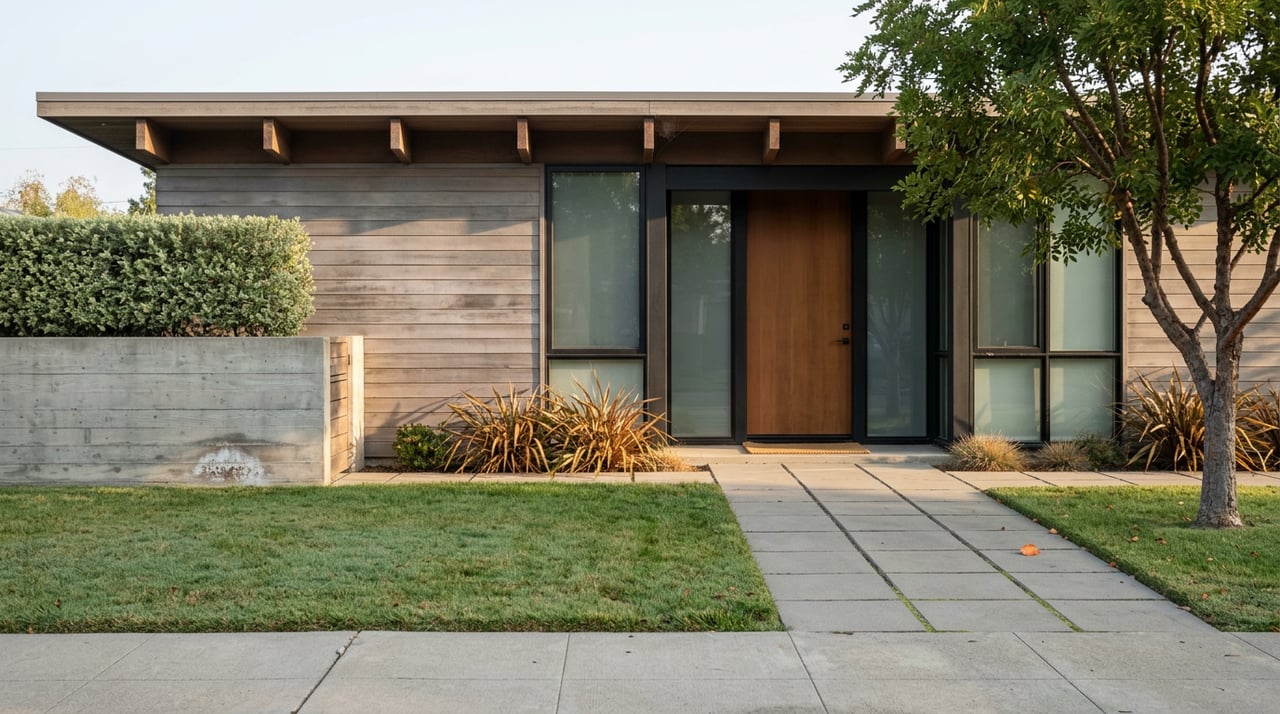
The second mechanism is architectural, and it lives almost entirely in zip code 94043. Monta Loma and pockets of Rex Manor and Cuesta Park hold a concentrated inventory of Eichler and Mackay-built mid-century homes, single-story post-and-beam houses built around indoor-outdoor floor plans. These homes typically trade between $1.6 million and $3.5 million depending on renovation quality and lot size, according to local brokerage estimates, but the price isn't the interesting part. The interesting part is who's bidding.
Eichler buyers tend to be a self-selecting group hunting specifically for that architecture, and they don't cross-shop against buyers looking at a Craftsman near downtown or a postwar ranch in Rex Manor. That narrower buyer pool means Monta Loma's pricing runs on its own internal logic, somewhat insulated from the broader citywide competition that pushes homes in other pockets above asking. It's a niche market operating inside a hot market, and it's part of why 94043's median lands lower than downtown's even though it includes homes within walking distance of Google's headquarters.
The third mechanism may affect a buyer's near-term calculus, and it concerns future housing supply rather than what's currently for sale.
Google's North Bayshore Master Plan, approved by the Mountain View City Council on June 13, 2023, calls for up to 7,000 new homes across a 153-acre area bounded by Charleston Road, Stevens Creek, Space Park Way, and Huff Avenue, alongside more than 3 million square feet of office space and more than 26 acres of parks. It's the kind of number that gets cited whenever someone argues Mountain View's tight inventory is a temporary problem. The plan's own timeline runs 30 years.
The project has undergone several changes. In April 2023, Google cut 350 inclusionary affordable units from the North Bayshore plan, a 25% reduction from what the company had promised in earlier versions. That November, Google ended its development partnership with Lendlease on the North Bayshore and Middlefield Park projects, with the company citing a review of its real estate investments amid "current market conditions." In 2024, Google canceled a separate 800,000-square-foot office expansion known as Google Landings, planned for a site between Rengstorff Avenue and Permanente Creek, after already clearing more than 800 trees from the property. The company later agreed to pay Mountain View between $533,500 and $703,000 to plant replacement trees throughout the city. As recently as early August 2026, Mountain View Voice reported that Google continues to roll back office and housing commitments in Mountain View even while renewing leases on office complexes in neighboring Sunnyvale.
North Bayshore remains an active project, according to the city's planning department, and a 30-year development agreement remains in place. The timeline matters for anyone weighing today's offer against the possibility that new supply could affect the market in the next year or two. The homes that exist right now, in the zip codes and micro-neighborhoods described above, are the market to consider in the near term.
Put these three mechanisms together and the citywide median stops being a useful compass. A downtown condo, a Cuesta Park ranch on the Los Altos School District side of the line, and a Monta Loma Eichler are not competing for the same buyer or responding to the same pressures, even though all three show up under the same $1.9 million headline. If you're comparing Mountain View against a neighborhood in a different city, the more useful exercise is comparing the specific pocket you're considering against its closest analog elsewhere, not against Mountain View's citywide number.
The practical takeaway is to ask sharper questions before you tour rather than after you've fallen for a house. Which district is this specific address assigned to, not which district serves the city. Is this a mid-century architectural product with its own buyer pool, or a more general single-family home competing against everything else on the market. And what is known about the timing of new supply, given a development timeline that spans decades and has undergone several changes?
Does a higher median price in downtown's 94041 zip code mean it's a better investment than 94040 or 94043? Not necessarily. The higher median reflects a different mix of housing stock, including newer construction and condos alongside older homes, rather than a straightforward statement that downtown outperforms other areas. The right comparison depends on the specific property type and what you're optimizing for, whether that's walkability, lot size, or architectural character.
Will the North Bayshore project eventually bring Mountain View prices down? The plan's own development agreement runs 30 years, and Google's history on this specific project includes multiple changes: cutting affordable units, ending its Lendlease partnership, and canceling a related office expansion. The timing and market effect of added supply remain uncertain.
How do I find out which school district a specific Mountain View address is assigned to? Boundary lines can run through the middle of a zip code or even a named neighborhood, so the only reliable method is confirming the assignment for the exact parcel, not relying on the city name or general area reputation.
Comparing Mountain View against a short list of nearby cities, or narrowing in on the specific pocket that fits your priorities, is easier with someone who tracks these boundary lines and submarket patterns block by block. Christopher Fling and the Fling Yang & Associates team work Los Altos, Palo Alto, and the surrounding Silicon Valley market daily. Request Your Home Valuation to start the conversation with a clear read on where your target neighborhood actually stands.
Stay up to date on the latest real estate trends.